
Navigation Tips
Did you know that you can find content quickly in an article by simply using the built- in search?
Here's how: Hold the Control key and 'F' keys down at the same time on the article you want to search. A menu displays near top right of screen ( highlighted below in orange). Enter what you're looking for. Software displays the number of instances in the article that match your search terms. Use the up/down arrows in the search menu to review each instance:
Want to print the article? Simply press the print icon, located in the top right corner of the article:
Recommended Position Setup
It is important to note why managing positions is so crucial for your Operations. If your agency staff cannot access product areas needed for their routine workflows and responsibilities, it can cause unnecessary frustration and possibly, missed tasks. Identifying internal workflows and adhering to your agency's SOPs can assist you in determining who will manage what, when and why. Next up? Include the right set of permissions. All positions come with built- in defaults, to save you time.
We recommend reviewing/considering SOPs as a great place to start. Why? Your standard operating procedures identify the moving parts and who manages them. It keeps us all on the same bus, heading in the same direction. Review Avail standard SOPs here: SOPs Introduction & Overview
Positions can easily include a variety of permissions, to account for varying operational practices and workflows across agencies. This is helpful for agencies with staff that 'wear many hats' and provides flexibility in your personnel assignments.
Position Permissions Examples
Some staff may fulfill multiple roles. Be sure to include all permissions for areas they'll touch in their routine workflows and tasking and consider your internal SOPs. Some positions, for this reason, will share permissions:
- A Road Supervisor may fill in as a dispatcher and might even drive pieces of work. Avail recommends that you assign additional functions to enable both 1) the ability to login to the vehicle MDT to drive for revenue service 2) includes Operations permissions for a dispatcher. These kinds of adjustments are made at the Position level.
- An Operations Manager may sometimes dispatch, or even drive if needed. Adjust all permissions to include the features they'll need access within their position.
- A Planner may sometimes dispatch or fill other duties at some agencies, due to size. Ensure they, too, have access to all features they need in their position.
- A Maintenance Supervisor may assist with vehicle parking if using Yard Management tools and there's no available staff. Ensure they have access to Vehicle Locations, in this case.
- Customer Service may need to assist with public messaging. Make sure they have access to the tool.
- Marketing may need access to the Public Messages Card setup a rich editor message to include pictures, screenshots, 3rd party URLS.
Initial Positions Setup
Your Avail Implementation team works with your team to review default positions and related functions during initial system setup during project implementations. Agency staff, such as IT, typically manage position updates and assignments for agency staff after project completion, or sooner, if desired by the agency and training has been completed.
Please consult Avail when making any additional changes to any position structure. Customer Portal https://www.availtecportal.com
IMPORTANT: If the distribution of labor changes over time, we strongly recommend consulting Avail Technical Support for assistance in modifying the position setup.
In this article we describe examples of some of the most common default positions.
- Bus Dispatcher
- Bus Operator
- Bus Supervisor
- Maintenance Manager
- Planner
- IT Manager (Sys Admin)
- Customer Service Agent
- Marketing
Available Positions:
Planner Position. Scroll down on the screen to review other permissions included in the planner position:
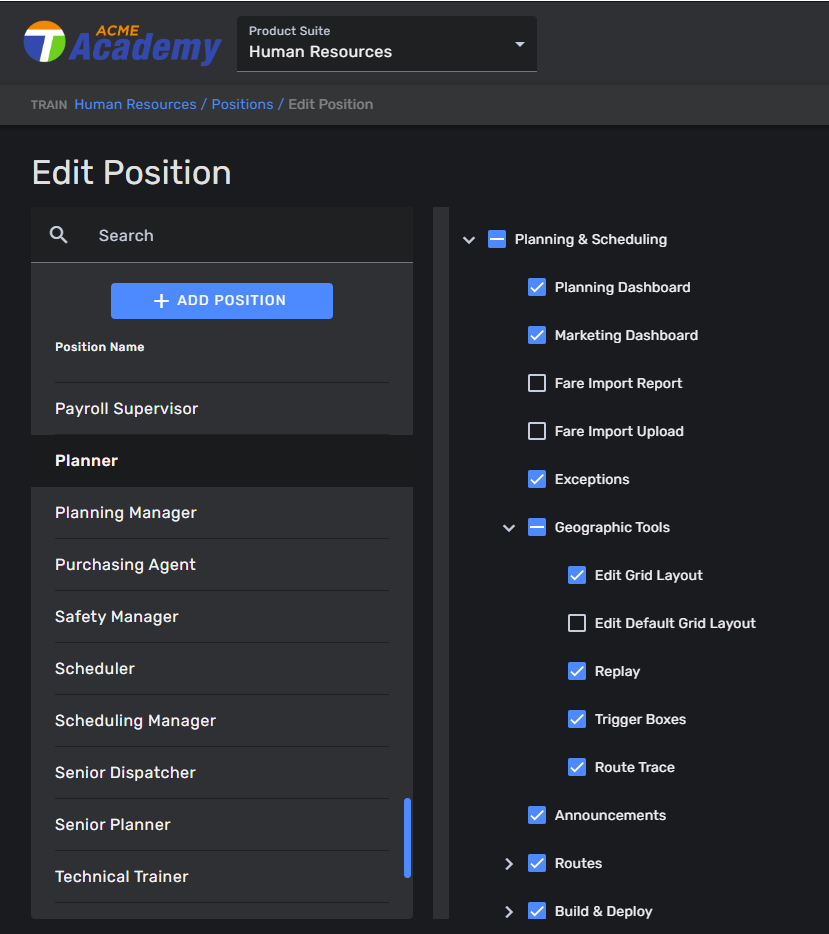
Default Planner Position Permissions
Schedule data is the foundation of your ITS system and data collection is measured against it. The default Planner position is appropriate for staff that manage creating the digital schedule (scheduling package vendor), making service changes, analyzing collected service data in BI planning reports for any needed service improvements, and maintaining the schedule data in the system. This position will be a primary position at a property with dedicated planning/scheduling staff. At a property where other staff maintain the service schedule, the role could be filled by a secondary position.
Important Things to Consider for Planning
The digital schedule data is the foundation of your ITS system. All data collection is compared to scheduled service. Initial schedule data deployments should be monitored for accuracy. They should include realistic, achievable run times, and match ridership service needs.
This Position Performs the Following Tasks
- Create schedule data and manage updates via a scheduling package vendor partner (Hastus, Trapeze, etc.)
- Build & Deploy - Product area used primary by planners/schedulers to import, validate, build run files and deploy a schedule to fleet vehicles for use on the road in real time.
- Review and analyze service-oriented planning reports in BI (e.g. Schedule Health, Running Times, Schedule Adherence…)
- May assist in planning long term detours
- Examples: Creating a long-term detour for a bridge replacement that will require a year or longer to complete. In this case, adjusting your digital schedule data may be beneficial, to account for the long- term service disruption. Agencies will make this determination.
- Add, change or remove stop announcements, prioritizing ADA compliant announcements
- Import, validate, build vehicle files (run information), and deploy schedule data and related files to fleet vehicles
- Review and update trigger boxes (virtual geofence around all serviceable stop locations)
- Review imported route trace paths for all active routes
This position is unlikely to require customization, as it contains all areas that require management for schedule data and use by default. Schedule data is the foundation of the system and all data collection is measured against your digital schedule. It is a crucial role/position.
The planner set of permissions may be required to add to other positions for smaller agencies where staff may manage multiple types of tasks (wearing many hats).
Internal Communications & Reporting
Reporting issues to your planning team is crucial: incorrect MDT schedule information, incorrect reporting in Operations ( trending false early stop departures- requires a review of BI reports to confirm it's schedule data and not due to vehicle operator behavior). Planners also have access to specific reports for analyzing schedule data as it is used on the road, to determine if improvements are needed and where. Planning reports should be reviewed regularly early on- after initial use of a digital schedule, then monthly- bi-monthly, or as determined by the agency's team.
Primary Planner Tools are Listed Below:
- ETMS > Planning > Import Card - First product area used primary by planners/schedulers to import the digital schedule into ETMS
- Build & Deploy - Second product area used primary by planners/schedulers to validate, build run files and deploy a schedule to fleet vehicles for use on the road in real time.
- Review any schedule changes/Correction deployments
- Likely heavily involved in decision- making processes for schedule data improvements, typically identified during reports analysis.
- Ask - Do we have different people managing the different steps for making changes in the schedule live, or is it one individual/a team? example: "Juan works with Csched to create our digital schedule. Meg manages the deployments of files to fleet vehicles and monitoring for issues."
- Is the planning for service changes separate from the deployment of those changes?
- Who enters data for the change?
- Who will manage entering System Adjustment entries for service deviations?
Default Planner Position Features
| ETMS Feature/myStop Tools | Functions Description |
| Import Tool | Planners use this UI card to import the digital schedule data (from a scheduling package) into Avail for its initial validation - software scrutinizes all imported attributes for the schedule to confirm accuracy: routes, blocks, runs, stops, stop to stop distances, trips, direction of travel (inbound outbound, headway, loops, service levels, etc. |
| Announcements | The tab used to create ADA vehicle announcements are assembled and maintained. NOTE: This applies to all in-vehicle announcement types and requires the files to be made and placed in an available location. |
| Geographic Tools | The card used to manage trigger boxes and route traces. Use the Replay tool to overlay a vehicle's breadcrumb trail on a map and then review trigger boxes to determine any schedule performance issues. Replay provides a way to review historical data collected from vehicles |
| Routes | This card controls information about routes included in the imported schedule data. Add GTFS information here - coloration for routes/text for online tools (myStop), define modes, type of service, set Operations alert thresholds, add fare sources per route, hide routes. |
| Build & Deploy | The tab used to re-validate the schedule data, build run files (these push to vehicle MDTs), set up deployment types to be distributed to fleet vehicles; making the data ready for use on the road |
| Live Map | Real time map interface- vehicle location, time, next 3 stop departure times, access to decision support & incident management tools. |
| Operations | Operations is populated by data collected from vehicles in real time. It includes a map interface, communications, and events tracking. This area is monitored by Dispatchers, Bus Supervisors or anyone involved with day-to-day operations who provide support to vehicle operators in service. |
| Special Events | The feature used by planners, to create temporary special service runs, for unique trips that are not included in the digital schedule data package. NOTE: This feature can include vehicles assigned to specific runs that also have a special radio talk group. Example: "We use special service to provide 4 trips each year to teach people how to ride the bus." |
| Exceptions Processing Card | Feature used to hold back APC and fare data in a temporary holding tank when the data does not match scheduled service expectations. This deliberate system process allows staff to scrutinize/review APC and farebox information, to attribute it to the right pieces of work, before saving and pushing the data over to ridership reports for final review. |
| Vehicle Assignment | The tab where vehicle block assignments are created and maintained. |
| Signs | The tab where myAvail signs are enabled or disabled. NOTE: Enabled and Disabled refers to their receiving and displaying information. |
| TSP | The tab where Traffic Signal Priority can be set up and managed. |
| Vehicle Files | The card where the user can review the status of all files scheduled for distribution to vehicles. This card is also used to schedule and deploy software to vehicle components. |
| Business Intelligence | The card used to review data collected from vehicles logged into revenue/non-revenue service. Key Planner Reports: Schedule Health, Running Times, OTP, Ridership/Farebox reports. BI provides standardized reports for Operations, Planning, Maintenance, Execs, Managers, Safety Trainers, and more. BI reports provide valuable metrics needed for agency reporting needs and, most importantly, for analysis of your system. |
| DataPoint - This application will be deprecated over time. Refer to Business Intelligence for all reporting needs. | |
| Setup/Adjustments Calendar | Enter System Adjustments to account for service deviations here. Detours that decrease/increase drive time, added vehicles - platoons, helpers, cancelled trips/runs. All entered deviations feed into your reporting metrics for NTD needs |
| Setup/System Admin/Work on Future Setup | Area used by planning to confirm all data imported correctly: review routes, service levels, manually entries for special service types/fares, fare mapping- MDT display, etc. |
| myStop applications (GTFS- routes/traces/stops), public- facing messages |
Real time information tracking online for vehicles in service in real time. Use myStop tools to confirm schedule data accuracy on public- facing maps. myStop Article: Real-Time-Passenger-Information-Tools-myStop-SMS-Alerts |
The default Planner position has access to the following myAvail suites, modules and their functions:
| ETMS Feature/myStop Tools | Functions Description |
| Planning & Scheduling/Exceptions | |
| Exceptions | Allows the access to the Exceptions Processing card where farebox data is validated against myAvail data, then made available for reporting. |
| Planning & Scheduling/Geographic Tools | |
| Edit Grid Layout | Allows to edit Replay Grid Layout. |
| Replay | Allows to view Replay of vehicle information. |
| Trigger Boxes | Allows to view, create, delete or modify Trigger box information. |
| Route Trace | Allows to view, create or modify Route Trace and Route Path information. |
| Planning & Scheduling/Announcements | |
| Announcements | Gives access to the Announcements tab. |
| Planning & Scheduling/Routes | |
| View | Allows to view Routes information. |
| Edit | Allows to edit Routes information. |
| Planning & Scheduling/Build & Deploy | |
| Data Import | Allows access to Data Import card where data can be imported. |
| Validate | Allows to validate schedule data. |
| Build Files | Allows to create vehicle run files from schedule data. |
| Deploy Files | Allows to deploy schedule data files to vehicles from the Build & Deploy tab. |
| Download Schedule Data | Allows to download schedule data files. |
| Download GTFS | Allows to make General Transit Feed Specification (A.K.A Google Transit files) available to Google. |
| Download Route Traces | Allows to make active for internal users and the public the selected Route Trace files from this tab. |
| Download Farebox | Allows to deploy Farebox configuration data files to vehicles from this tab. |
| Planning & Scheduling/Vehicle Files | |
| View | Makes the Vehicle Files card available for this position. |
| Planning & Scheduling/TSP | |
| TSP | Area used to setup the Traffic Signal Priority pre-emption feature. |
| Operations/Dispatch/Operations Views/Map | |
| View | Makes the standard vehicle map window available for this position. |
| Operations/Dispatch/Operations Views | |
| Status Window | Makes the Status window available for this position. |
| Vehicle History | Makes the Vehicle History window available for this position. |
| Route Status Grid | Use the Route Status in unison with the Route Map area. The Route Status/Map areas focus on individual routes for review. NOTE: Tracking vehicle capacity and headway are available in this area if the following is true: Capacities are input on the Vehicle Card. Headway service is included in the digital schedule data. |
| Route Ladder | Route Ladder provides a view of vehicles on routes in real time with visual spacing indications. Useful for headway route monitoring, and others, as preferred |
| Operations/Dispatch/Operations Views/Pullout | |
| View Only | Makes the Pullout window available for this position. |
| Operations/Special Events | |
| View | Makes the Special Events tab available for this position. |
| Edit | Allows the user of this position to edit values in the tab. |
| Operations/Legacy BI | |
| Legacy BI | Allows access to the Legacy Business Intelligence. |
| Operations/Setup/Signs | |
| View | Makes the Signs tab available for this position. |
| Edit | Allows to edit values in the Signs tab. |
| Business Intelligence | |
| View Business Intelligence | Allows to view Business Intelligence. |
| Systemwide Reporting |
Allows access to all properties in a multiple property installation. NOTE: The default is to allow access only to the property the user is logged into. |
| DataPoint - This application will be deprecated over time. Refer to Business Intelligence for all reporting needs. | |
| Setup/Adjustments Calendar | Review imported schedule data- reportable miles and hours, trips scheduled per day, service levels, active routes, Special Service related data entries, fare mapping. Enter System Adjustments to account for service deviations here. |
Default Dispatcher Position
The default Dispatcher position is the primary position for dispatchers. Dispatchers primarily monitor vehicles in service in real time, to provide vehicle operators support, and to address any safety and OTP issues. Responsibilities importantly include using detour management tools, incident management and decision support tools for service interruptions, creating messages for the public, managing vehicle operator swaps, cancellations, additions to service, etc., as needed.
Important Things to Consider for Dispatching
Planners create the digital schedule data for use by vehicles logged in via the MDT (operator workflow). Built- in system alerts received in Operations (events) are based on how the schedule is used on the road in real time. If issues seem to be trending, it is helpful to share this with your planning team, so they can review planning reports to identify where issues are and make corrections in the schedule data itself. Internal communication needs for this position help all your teams ensure you have and use a great digital schedule!
How it Works: Create digital schedule > Deploy to vehicles > Operator logon via the MDT connects vehicle to its piece of work/run > data collection occurs based on vehicle activity > events generated in Operations > dispatch monitors (take, respond if needed, log) > events file to BI operations & planning reports > Review for trends: planning - schedule data reports, managers
Note: All BI reports include data for review for
This Position Performs the Following Tasks:
- Monitor system operations in real-time
- Monitoring operational needs, communications, and using disruption tools to track vehicle swaps, incidents, etc.
- Reference Live Map for real time vehicle activity
- Respond to system generated events as needed
- Track and record vehicle incidents
- Use decision support tools for service interruptions
- Create detours for impact zones
- This includes reviewing built-in public messages
- Review and adjust operator/vehicle assignments for on the fly needs: decision support
- Geo Tools: Replay tool - If permissions are granted in Dispatch position: to research historical data for operator/vehicle activity.
- Vehicle Incidents - Permissions are enabled in Dispatch position. Document new vehicle incidents/service time interruptions. Permissions to edit is based on agency preference.
The focus is on day-to-day aspects of the system’s operation. Employees with the dispatcher position will spend most of their time in Operations, Live Map and the Detours areas. The number of people with this position assigned depends on the size/preference of the property and number of shifts.
This position likely requires some customization. Why: Default positions may not match how your agency practices. Consider your internal workflows and SOPs:
- Do all dispatchers have the same set of responsibilities?
- Are some dispatchers granted permissions that others are not? Use of the Replay tool for troubleshooting is an example.
- Are there fill-in or temporary/replacement dispatchers with restricted permissions?
- Who handles public messaging - all dispatchers, customer service, marketing?
- Can different dispatchers create “canned messages" for reuse?
- Is Pullout/Yard Management installed? If so, who manages vehicle inputs/updates for your yard map?
- Do you want a Road Supervisor to have access to reports?
Default Dispatch Position Features
| ETMS Feature | Functions Description |
| Operations | This is the core Operations area for ETMS/myAvail. This primary area is monitored by dispatchers, bus supervisors or anyone involved with day-to-day operations |
| Detour | Feature used to create detours, turn by turns, and related messaging for internal and public distribution. |
| Live Map | Use Live Map to monitor all vehicles in service: location, status, upcoming 3 stop departures, access decision support & vehicle incident tools, monitor fueling needs (varying vehicle types) |
| Decision Support Tools | Service disruption tool used to keep service on time. Document cancelled service/inform riders via myStop, perform vehicle swaps, add vehicles to trips running late- Helpers, add Platoon for vehicles at capacity/headsign update to notify riders on the street - "bus full" (catch the Platoon instead) |
| Vehicle Incidents | The card used to document new incidents, upload attachments, edit/close, and to review existing documentation. Can be configured to auto- create work orders in ETMS ( if configured) |
| Canned Messages | Feature used to review stock messages, and create others for reuse in the system. These are used for internal communications with vehicle operators. |
| Public Messages | Feature used to generate public messages. |
| Route Ladder | Route Ladder provides a view of vehicles on routes in real time with visual spacing indications. Useful for headway route monitoring, and others, as preferred. |
| Time Line | Time Line provides a view of vehicles en route/, and its schedule for the day for tracking purposes and making predictions for future stops/ driver swaps, etc.- similar to Route Ladder but for not specific to headway service. |
| Special Events | The feature used by planners, is to create temporary special service runs, for unique trips that are not included in the digital schedule data package. NOTE: This feature can include vehicles assigned to specific runs that also have a special radio talk group. Example: "We use special service to provide 4 trips each year to teach people how to ride the bus." |
| TIS | The Traveler Information System is accessed here to add available signage messages for routes, bays, vehicles. NOTE: This is used with an add-on package and is not installed for all properties. |
| Vehicle Locations | The feature used to indicate parking locations in the yard/on the yard map. May require integration with 3rd party vendor. NOTE: Includes ability to identify out of service vehicle(s) for maintenance. Bus Hostlers may manage vehicle parking/related documentation, if installed. |
| Geographic Tools | ETMS card used to review historical data collected from vehicles in service/troubleshoot issues that occurred. Planners also use this feature to manage and maintain some digital schedule data attributes - trigger boxes and route traces. |
| Exceptions Processing Card | Feature used to hold back APC and fare data in a temporary holding tank when the data does not match scheduled expectations. This deliberate system process allows staff to scrutinize/review APC and farebox information, to attribute it to the right pieces of work, before saving and pushing the data over to ridership reports for final review. |
| Business Intelligence | The card where access is provided to Business Intelligence reports. BI provides standardized reports for Operations, Planning, Maintenance, Execs, Managers, Safety Trainers, and more. BI reports provide metrics needed for agency reporting needs and importantly, for analysis of your system. |
| SSRM Card | A stand alone reporting tool that allows additional reports to be built by retrieving data metrics from the data warehouse. This tool allows for customization. |
Default Dispatch Position Permissions
The default Bus Dispatcher position has access to the following ETMS suites, modules and their functions:
Default Maintenance Manager Position Permissions
The Maintenance Manager position is for an employee who oversees your maintenance team. This includes determining who should have access to EAM and other maintenance tools in ETMS (maintenance personnel assignments, setting permissions, work orders, daily work orders, work order interactive display, work order display, preventative maintenance and forecasting, inventory management- parts, tire tracking, responding to maintenance alerts, such as vehicle health monitoring (J1939/J1708).
This position typically oversees other positions, such as maintenance supervisors, maintenance technicians, parts room staff, etc. to ensure all work orders are being created, managed, assigned, and tracked toward completion- all to keep your service vehicles on the road.
This position also has direct access to maintenance features in ETMS (if included in project implementation plan). If installed for a property, features can include all or a variety of tools: EAM work orders, daily work orders, work order interactive display, work orders display, preventative maintenance inspections & forecasting, parts inventory, tire tracking, vehicle health monitoring (VHM), and reporting metrics.
How it Works: Digital schedule deployed to vehicles > Operator logon via the MDT connects vehicle to its piece of work > Vehicle health data collection occurs in real time >alerts-1939/VHM, J1708/ fares, headsigns, ITS, pretrip issues > Data populates Operations queues, in real time > alerts data moves to maintenance reports end of day> Maintenance creates work orders, assigns tasks, manages parts, inventory, PM cycles for assets, etc. > GOAL: vehicles are road worthy, reduce service limitations.
Did you know? Maintenance reports include the ability to review DVIR results if created in ETMS. Driver Vehicle Inspection Screens are a DOT requirement. Some agencies bypass paper and satisfy this requirement via ETMS by creating electronic vehicle inspections ( Pass/ Fail status, and included Reason Codes for failures). These are then used by vehicle operators to report on vehicle condition via the MDT.
Things to Consider for Maintenance
Leverage built- in maintenance features, such as the ability to create work orders from incidents in ETMS, if using electronic WOs in ETMS. Maintenance also has access to a variety of reports to analyze any issues noted as trending: Live Maintenance Queue, BI Maintenance reports ( DVIR, ITS, VHM Issues), Maintenance Dashboard, Live Map, real-time information in Operations (Maintenance Queue). TIP: Some reports access depends on ITS setup. Determining who should have access to the different features is important, to ensure there are no interruptions to your team's work in real time and nothing has been missed.
Maintenance assignments can be managed by other staff, such as a Maintenance Supervisor/Lead. This is based on individual agency practices. This secondary position may handle and assign work orders, directing the actions of your maintenance team.
This Position Performs the Following Tasks:
- Responsible for overseeing all maintenance needs
- Assign work orders or task supervisory individual with assigning work orders
- Review maintenance needs and trends in maintenance reports- maintenance queue- for real time information, and BI and ERP maintenance reports are recommended for review weekly, monthly - as determined by agency
- Reference the Live Map - vehicle status, location in real time
- Can reference Operations to review vehicle information in real-time ( time and location), including system status and any maintenance alerts.
Maintenance events populate the BI Maintenance Issues report, to allow review when needed/to identify any trending issues.
Operations queues include information in real time:
- Maintenance Queue
- Operations Map
- View Vehicle locations in the vehicle yard
- View Pullout information
- Block/Run Schedule
Default Settings: This position may require customization. Why- Default settings may not fully apply to your agency's unique practices. It is important to consider which ITS tools you have installed, along with your workflow and internal SOPs. Review Avail standard SOPs here: SOPs Introduction & Overview
Example: Some agencies have AEM tools installed. These enable use of electronic work orders, PM inspections and forecasting, part inventory, tire tracking, and related documentation. Specific reports are also installed based on agency ITS configurations and preference; and may include ERP Maintenance, Live Maintenance Queue, Maintenance Dash, Business Intelligence Maintenance Issues, New Pre-Trip Issues
- Who should be able to create work orders in ETMS, and who will assign them?
- Will dispatch convert ETMS incidents into work orders for maintenance (if WOs are installed)?
- Who will be responsible for reviewing maintenance reports and how often will be needed?
- Do we have multiple techs who use a shared workstation? Do they use individual setups?
- Who will manage vehicle parking locations in the yard throughout the day- pullins, pull outs, if we use yard management tools? Do we have a dedicated bus hostler/yard coordinator.
- Will Maintenance assist with vehicle software updates or is this an IT function?
- Do we have parts room staff to manage inventory or will this be a maintenance tech?
Default Maintenance Position Features
| ETMS Feature | Functions Description |
| Fleets Card | The card used for defining your fleet groups in the Transit Assets product suite in ETMS. Fleets are defined by make, year, model. “Fleet Groups” provide a way to divide your vehicle fleets into manageable groups. |
| Vehicles Card | This card, located in Transit Assets, is used to input all revenue/non-revenue vehicles in your ITS system. All entries much be assigned to a Fleet group. Enter the vehicle's unique Id and software version. |
| Maintenance Queue Report | This report provides information for vehicle health alerts (VHM), pullout/ pull in schedule times, and vehicle location on a live map. |
| Unplanned Maintenance Report | This dash provides a view of overall vehicle health, associated costs, road calls, upcoming maintenance needs (due soon alerts) |
| ETMS Work Order Management Settings | Transit Assets: This card is used to setup all attributes needed to generate work orders in ETMS. Includes employees, class codes, operations codes, repair types |
| ETMS Work Orders Card | This card in ETMS > Transit Assets is used to generate, assign, update, close all electronic work orders, and track all historical entries. |
| ETMS Daily Work Orders | Transit Assets: Designed for individual supervisors/use on an individual's computer/rugged laptop. Also enabled for shared accounts access to work orders on a singular workstation. |
| Work Order Assignment | Transit Assets: Designed for supervisors/review, assign, edit, work orders |
| Work Order Display | System Admin > Displays all work orders on a large screen for easy viewing/track WOs, assignments, status/progress |
| ETMS Work Order Interactive Display | System Admin > Designed for shared accounts to access/clock in and out to document work against work orders on a shared workstation/rugged laptop. Multiple technicians can clock in and out of single WOs here. |
| Deferred Asset Defects | This card provides a way to document non- safety related defects noted on vehicles. Defects can be attached to work orders in ETMS. |
| Operations | This is the core of overall Operations. This is the area that Dispatchers, Bus Supervisors or anyone involved with direct day-to-day operations will spend most their time monitoring and supporting service in real time and managing communications. The Maintenance queue in Operations is targeting vehicle issues in real time, if using J1939 and other configurations. |
| Vehicle Incidents Card | Compliance: The card used to create incidents/review/attach to work orders ( if configured), and edit existing incidents. Includes ability to attach related documents, Use of incident tool is based on permissions. (assign, edit and close features). NOTE: The work orders feature can be enabled if your agency purchased the add-on package. It is not installed by default for all properties. |
| Inspection Settings/DVIR | The tab where DVIR inspection settings are created and maintained for vehicle operator use on the MDT. NOTE: This feature is used with an add-on package and is not installed for all properties. |
| Business Intelligence | The card is used to review Business Intelligence maintenance reports for overall vehicle health/ITS monitoring. This tool provides the ability to review individualized data and trends over time. |
| Build & Deploy | The tab where schedule data is validated, packaged for distribution to vehicles and deployed to vehicles. |
| Geographic Tools | The planning card where past vehicle activity, trigger boxes and route traces are viewed, created or maintained. |
| Vehicle Files | This card is primarily used by Avail technical staff to schedule and deploy software, debug code, etc., to fleet vehicle components. It can also be used to review the status of all files scheduled for download/distribution to vehicles. |
| PM Forecast & Checklist | Transit Assets > Used to forecast upcoming inspection cycles, review the PM check lists, assign the work order to staff |
| Parts Inventory | Transit Assets: Create and track all information for parts in ETMS. Includes basic info, part location, vendor, perpetual info, notes, audit trail. Attach to electronic work orders |
| Tire Stock | Transit Assets: Document tires by year, make, model, vendor, size, leased, owned, tread depth/recapped when, ability to clone sets |
| Vehicle MDT | Operator Tool: (mobile data terminal) Interface tablet- displays run/block information stored in the IVU. Login connects vehicle to scheduled piece of work/begins data collection against the schedule. Reference for vehicle operator (route, run, trip, next 3 stops and depart times) |
The default Maintenance Manager position has access to the following myAvail suites, modules and their functions:
| ETMS Feature | Functions Description |
| Planning & Scheduling/Geographic Tools | |
| Edit Grid Layout | Allows to edit Replay Grid Layout. |
| Replay | Allows to view Replay of vehicle information. |
| Planning & Scheduling/Build & Deploy | |
| Download Pre-trip | Allows to download Pre-trip information. |
| Planning & Scheduling/Vehicle Files | |
| View | Makes Vehicle Files available for this position. |
| Operations/Dispatch | |
| Edit Operations Layout |
Allows to alter the number of windows and content of all regions of the Operations tab for this position. NOTE: Each position can have a separate operations layout. *Status queue is not modifiable |
| Save Default Operations Layout |
Allows to set their operations tab layout for this position as the default layout for all users. NOTE: This permission should be turned on, the new default layout created and saved and then this permission removed to prevent accidental changes. |
| Operations/Dispatch/Operations Views/Maintenance Queue | |
| Handle Maintenance | This selection allows the user of this role to select a Maintenance queue entry, respond to the event then log the event. |
| Operations/Dispatch/Operations Views/Map | |
| View | Makes the standard vehicle map window available for this position. |
| Operations/Dispatch/Operations Views | |
| Block/Run Schedule | Makes the Block/Run schedule window available for this position. |
| Operations/Dispatch/Operations Views/Pullout | |
| View Only | Makes the Pullout window available for this position. |
| Operations/Dispatch/Queue Actions | |
| Pre-trip |
View the pre-trip failures reported for the selected vehicle. NOTE: This option requires use of the vehicle pre-trip module which is an optional feature of myAvail. |
| Create Work Orders |
Opens a window for the generation of a maintenance work order. NOTE: This is only available when using the Avail Fleet-Net® product. |
| Operations/Incidents | |
| View |
Allows to view incidents. NOTE: This is used with an add-on package and is not installed for all properties. |
| Operations/Legacy BI | |
| Legacy BI | Allows access to the Legacy Business Intelligence. |
| Operations/Setup/Inspection Settings | |
| Inspection Settings | Allows access to the Inspection Settings tab where myAvail Pre-Trip inspections settings are created and maintained.. |
| Business Intelligence | |
| View Business Intelligence | Allows to view Business Intelligence. |
| Systemwide Reporting |
Allows access to all properties in a multiple property installation. NOTE: The default is to allow access only to the property the user is logged into. |
| Operations/DataPoint | Will be deprecated over time. Planners use area for some schedule data attributes. Refer to Business Intelligence for reporting needs. |
| DataPoint: Planners Feature |
System Adjustments Calendar - Use to account for service deviations and additions > feeds into overall NTD metrics for reporting (accidents, cancellations, added service Use this area to review imported schedule data and its related attributes: miles, hours, trips per day, active routes. Can review imported service levels, enter manual special service pieces, and related fares- for collection outside of your standard system. Other entries may include fare structures for the MDT interface, company data, garage information, vehicle information, etc. *Use Business Intelligence reports for maintenance reporting needs |
| Operator | |
| Vehicle MDT | Operator Tool: (mobile data terminal) Interface tablet- displays run/block information stored in the IVU. Login connects vehicle to scheduled piece of work/begins data collection against the schedule. Reference for vehicle operator (route, run, trip, next 3 stops and depart times) |
| Personnel | |
| Event Email Alerts |
Allows the assignment of events that will generate an email to the user. NOTE: Use of this option requires there are events configured to generate email alerts. |
| Event Text Alerts |
Allows the assignment of events that will generate SMS Text messages to the user. NOTE: Use of this option requires there are events configured to generate text alerts. |
| Incident Email Alerts |
Allows the assignment of Incidents that will generate an email to the user. NOTE: Use of this option requires there are Incidents configured to generate email alerts. |
| Incident Text Alerts |
Allows the assignment of Incidents that will generate SMS Text messages to the user. NOTE: Use of this option requires there are Incidents configured to generate text alerts. |
Default Vehicle Operator Position Permissions
This position is responsible for login to the MDT in the vehicle to drive. Login begins data collection for all revenue service performed for the vehicle. Vehicle operator picks up and drops passenger off throughout their shift.
Default Vehicle Position Features
| ETMS Feature | Functions Description |
| Vehicle Operator | |
| Operator Type | Add the assignment of an operator by type (e.g. Full Time, Part Time or Extra board). This is not a required field unless it's being used for pullout features. Check the box for extraboard operators to enable available operators to display on the Extraboard Operators grid for dispatch reference. |
| Driver Logon ID | Used for vehicle operators to login via the MDT. This connects the driver to the piece of work scheduled for the vehicle to perform. |
Important Things to Consider for Vehicle Operators
The Bus Operator position is a required and crucial system position. When a vehicle is logged in to, it is connected to the digital schedule, which is stored in the IVU (in vehicle unit). The vehicle collects revenue and non-revenue data against the run/block logged into by the operator, and the service is visible to ridership online (myStop/myStop phone apps). If issues trend, it is helpful to inform dispatch, so the feedback can be shared with planning (team who manages the digital schedule data and any needed improvements)
This position is unlikely to require customization, unless you use pullout management tools and extraboard operators should populate as available on the Pullout grids. In this case, include 'Extraboard' in their vehicle operator account.
Default Operations Supervisor Position Permissions
The default Bus Supervisor position is the primary position for supervisors who work on or assign work for vehicles and assets. Bus Supervisors can have different responsibilities, as agency practices and role responsibilities vary. These staff may use mobile devices such as rugged laptops, tablets or computer workstations.
Important Things to Consider for Supervisors
Planners create the digital schedule data for use by vehicles logged in via the MDT (operator workflow). Built-in system alerts received in Operations (events) are based on how the schedule is used on the road in real time. If issues seem to be trending, it is helpful to share this with your planning team, so they can review planning reports to identify where issues are and make corrections in the schedule data itself. Internal communication needs for this position help all your teams ensure you have and use a great digital schedule!
How it Works: Create digital schedule > Deploy to vehicles > Operator logon via the MDT connects vehicle to its piece of work/run > data collection occurs based on vehicle activity > events generated in Operations > dispatch monitors (take, respond if needed, log) > events file to BI operations & planning reports > Review for trends: planning - schedule data reports, managers - operations reports
This Position Performs the Following Tasks:
- Monitor and support vehicles on the road to ensure overall revenue performance is on time and safe
- Using Operations for real time updates
- Respond to communications and events as needed
- Record vehicle incidents in ETMS > Compliance Vehicle Incidents card
- Record disruption management events > Decision Support Tools
- Set up fixed route detours
- Review built-in messaging for all available channels
- Ridership - myStop online tools
- Vehicle operators - MDT turn by turn
- Review built-in messaging for all available channels
- Review and adjust operator/vehicle assignments for on the fly needs: decision support
- Geo Tools - If permissions are granted in Dispatch position: to research historical data for operator/vehicle activity.
- Vehicle Incidents - If permissions are granted in Dispatch position: to research historical data for operator/vehicle activity.
- This includes using Replay and the Incident tracking system
- Review operations related reports to identify needs and trends (System Events Dashboard, Events, Logon, Log off reports)
The focus is on day-to-day aspects of the system’s operation. Employees assigned to this position will spend most of their time in Operations. The number of people with this position depends on the size of the property and number of shifts.
This position likely requires customization. Consider your workflows and SOPs:
- Do all Bus Supervisors have the same set of responsibilities?
- Are some bus supervisors allowed certain permissions and others are not?
- Ensure all fleet groups in service are actively monitored
- Ensure Decision Support & Incidents tools are used for tracking needs in ETMS ( overall reporting metrics)
- Who handles short term detours for accidents or other temporary road closures?
- Who handles public messaging on short term detours?
- Do Bus Supervisors need historical information related to vehicles or operator performance?
- Will this position need to access reports?
- Will this position need to access Replay?
Default Road Supervisor Position Features
| ETMS Feature | Functions Description |
| Operations | This is core myAvail Operations. This is the area that Dispatchers, Bus Supervisors, or anyone involved with day-to-day operations will spend most their time monitoring service in real time. |
| Detour | The area where detour information is created, maintained and prepared for internal and public distribution. |
| Live Map | Real time map interface - vehicle location, time, next 3 stop departure times, access to decision support & incident management tools. |
| Canned Messages | The area in Operations where stock messages are created and maintained. NOTE: These are messages used for internal communications. |
| Public Messages | The feature used to create and manage public messages. Historical entries are also maintained here. |
| Vehicle Incidents | ETMS > Compliance - The card used to document incidents and maintain historical entries. |
| Decision Support Tools | Service disruption tool used to keep service on time. Document cancelled service/inform riders via myStop, perform vehicle swaps, add vehicles to trips running late- Helpers, add Platoon for vehicles at capacity/headsign update to notify riders on the street- "bus full" (catch the Platoon instead) |
| Special Events | The feature used by planners, to create temporary special service runs, for unique trips that are not included in the digital schedule data package. NOTE: This feature can include vehicles assigned to specific runs that also have a special radio talk group. Example: "We use special service to provide 4 trips each year to teach people how to ride the bus." |
| Route Ladder | Route Ladder provides a view of vehicles on routes in real time with visual spacing indications. Useful for headway route monitoring, and others, as preferred. |
| Fleets Card | The card where myAvail Fleet Groups are defined and maintained. “Fleet Groups” provide a way to divide the vehicle fleet into manageable groups or areas of operation for control by multiple Dispatchers. Fleets include designating different vehicles by make, model, and year |
| Vehicle Locations | The area where the location in the yard is entered and maintained. NOTE: This feature can also be used to identify vehicle(s) that are out of service for maintenance reference. |
| Build & Deploy | The area where schedule data is imported from a digital scheduling package into ETMS. Data is then validated, run files are built, and scheduled for distribution to vehicles (deployed). Planners typically manage this area, though smaller agencies may include these permissions for other positions. |
| Geographic Tools | ETMS card used to review historical data collected from vehicles in service/troubleshoot issues that occurred. Planners also use this feature to manage and maintain some digital schedule data attributes- trigger boxes and route traces |
The default Bus Supervisor position has access to the following myAvail suites, modules and their functions:
| ETMS Feature | Functions Description |
| Planning & Scheduling/Exceptions | |
| Exceptions | Allows the access to the Exceptions Processing card where farebox & APC data is validated against myAvail data, then made available for reporting. |
| Planning & Scheduling/Geographic Tools | |
| Edit Grid Layout | Allows to edit Replay Grid Layout. |
| Edit Default Grid Layout | Allows to edit Default Replay Grid Layout. |
| Replay | Allows to view Replay of vehicle information. |
| Planning & Scheduling/Build & Deploy | |
| Download Schedule Data | Allows to deploy schedule data files to vehicles from the Build & Deploy tab. |
| Operations/Operations Dashboard | |
| Operations Dashboard | Allows to view Operations Dashboard. |
| Operations/Dispatch | |
| Edit Operations Layout |
Allows to alter the number of regions on Operations. NOTE: Each position can have a separate operations layout. *NOTE: Status queue is not modifiable. |
| Save Default Operations Layout |
Allows to set their operations layout for this position as the default layout for all users. NOTE: This permission should be turned on, the new default layout created and saved and then this permission removed to prevent accidental changes. |
| Active Dispatcher | This selection indicates to myAvail if the user assigned to this position is expected to respond to issues within the fleet groups to which they are assigned. This selection must be on for Dispatcher position or any position with dispatcher capabilities assigned that may cover for Dispatch as needed. This setting should be off for position being given View access to dispatch capabilities such as Planner. |
| Operations/Dispatch/Operations Views/Comm/Event Queue | |
| View | Allows to access the Communications Queue window and the Event Queue window. |
| Handle Comm/Event Queue | Allows to select a communications or events queue entry, respond to the event then log the event. |
| Operations/Dispatch/Operations Views | |
| Timeline | Makes the Timeline window available for this position. |
| Operations/Dispatch/Operations Views/Map | |
| View | Makes the standard vehicle map window available for this position. |
| Build Custom Map View | Allows the user to create custom map views. |
| Operations/Dispatch/Operations Views | |
| Status Window | Makes the Status window available for this position. |
| Vehicle History | Makes the Vehicle History window available for this position. |
| Block/Run Schedule | Makes the Block/Run schedule window available for this position. |
| Text History |
Makes the Test History window available for this position. NOTE: This is a history of text messages from the currently selected vehicle. |
| Sent Messages |
Makes the Sent Message window available for this position. NOTE: Sent messages refers to Dispatcher messages and will display delivery failures and responses when applicable. |
| Route Status Grid | Makes the Route Status window available for this position. NOTE: Tracking vehicle capacity and headway are optional and configured separately. Capacities are set on the Fleet card. Headway service must be included with the digital schedule data import. |
| Route Status Map | Makes the Route map available for this position where the user can view route map. NOTE: Tracking vehicle capacity and headway are configured separately. Capacities are set on the Fleet card. Headway service must be included with the digital schedule data import. |
| Mobile Personnel Grid |
Makes the Mobile Personnel Grid window available for this position. NOTE: The ability to update, add and view the status of mobile personnel is all granted by this permission. |
| Platform Management |
Makes the Platform Management window available for this position. NOTE: The ability to view and update vehicle block assignments are granted by this function. This function is not granted to any position by default. If Platform Management is used a custom position should be created. |
| Operations/Dispatch/Operations Views/Pullout | |
| View Only | Makes the Pullout window available for this position. |
| Assignments | Allows to assign operators and vehicles to runs. |
| Check In |
Allows to check in Operators in the Pullout window. NOTE: This does not control the check in of Extra board operators in the Yard Map Grid. |
| Operations/Dispatch/Queue Actions | |
| Text Message | Opens the window to prepare a text message to one or more vehicles. |
| Voice Call |
Opens a radio call window. NOTE: This is only appropriate for closed MIC systems. |
| Pre-trip |
View the pre-trip failures reported for the selected vehicle. NOTE: This option requires use of the vehicle pre-trip module which is an optional feature of myAvail. |
| Create Vehicle Incident | Opens the Vehicle Incident with information available from this item, if any, pre-filled on the form. |
| Location SMS Message |
Allows to send a vehicle or map location by standard public text message. NOTE: This is only available on the Map window. |
| Create Work Orders |
Opens a window for the generation of a maintenance work order. NOTE: This is only available when using the Avail Fleet-Net® product. |
| Video Tagging | Allows to give a tag to a video. |
| Operations/Dispatch/Dispatcher Actions | |
| Auto Response | Allows to set the system into auto response mode when no other staff is available to monitor vehicle events or communication requests. |
| Manual Log On | Allows to log an operator onto a selected vehicle and run. |
| Manual Log Off | Allows to log off a selected vehicle. |
| Reset Vehicle |
Allows to reset the status of a selected vehicle. NOTE: The primary purpose is to clear vehicles that have returned to the yard but were not logged off before shutting down. |
| Documents | Allows to view reference documents. |
| Block Delay | Allows to delay the start of a selected vehicle block of work. |
| Block Status | Allows to enable or disable departure estimation for a selected vehicle block of work. |
| Operations/Profile | |
| Edit Default Fleet Groups |
Allows to edit the fleet groups they are monitoring. NOTE: This option is the “gear” menu instead of the drop-down menu. |
| Edit Default Talk Groups |
Allows to edit the talk group they are using. NOTE: This option is the “gear” menu instead of the drop-down menu. |
| Mobile User | Allows the user to set their mobile status and identify their assigned vehicle and phone. Assigning this function also indicates this is a “mobile” position. |
| Operations/Decision Support | |
| Decision Support |
Opens a separate browser window to support actions needed to address a service disruption. NOTE: This is an optional feature, contact your FAST representative before activating. |
| Operations/Detours | |
| View Detours | Allows to view detours. |
| Operations/Incidents | |
| View |
Allows to view incidents. NOTE: This is used with an add-on package and is not installed for all properties. |
| Create |
Allows to create incidents. NOTE: This is used with an add-on package and is not installed for all properties. |
| Edit |
Allows to edit incidents. NOTE: This is used with an add-on package and is not installed for all properties. |
| Close/Reopen |
Allows to close/reopen incidents. NOTE: This is used with an add-on package and is not installed for all properties. |
| Operations/Public Messages (CAD/AVL)/Messages | |
| View |
Makes the Public Messages feature available for this position. NOTE: Applies to Web and Sign Messages only. |
| Edit | Allows to add, edit or make inactive Web and Sign Messages. |
| Publish |
Allows to activate public announcements to notify the public. NOTE: This allows a user to create announcements and distribute them internally for review. |
| Operations/Public Messages (CAD/AVL)/In-Vehicle Announcements | |
| View |
Makes the Public Messages feature available for this position. NOTE: Applies to in-vehicle announcements only. |
| Edit | Allows to add, edit or make inactive in-vehicle announcements. |
| Operations/Public Messages (CAD/AVL)/Ad-hoc Messages | |
| Adhoc Messages | Ad Hoc messages can include 'one-time' internal signage and audio messages to alert riders/vehicle operators of situations in the vehicle. If enabled, this allows to create & view Ad-hoc messages |
| Operations/Vehicle Locations | |
| Vehicle Locations |
Makes the tab where the location in the yard is entered and maintained available. NOTE: This tab also identifies vehicle(s) that are out of service for maintenance. |
| Operations/Special Events | |
| View | Makes the Special Events tab available for this position. |
| Edit | Allows the user of this position to edit values in the tab. |
| Operations/Legacy BI | |
| Legacy BI | Allows access to the Legacy Business Intelligence. |
| Operations/TIS | |
| View TIS | Allows to view the Traveler Information System functionality. |
| Operations/Setup/Fleet Groups | |
| Fleets Card | Allows access to the Fleet card in ETMS where myAvail Fleet Groups are defined and maintained. |
| Operations/Setup/Canned Messages | |
| View Dispatcher Messages | Allows to view the Dispatcher prepared messages in the tab. |
| Edit Dispatcher Messages | Allows to add, edit or delete the Dispatcher prepared messages in the tab. |
| View Operator Messages | Allows to view the Operator prepared messages in the tab. |
| Edit Operator Messages | Allows to add, edit or delete the Operator prepared messages in the tab. |
| Operations/Setup/Signs | |
| View | Makes the Signs tab available for this position. |
| Edit | Allows to edit values in the Signs tab. |
| Business Intelligence | |
| View Business Intelligence | Allows to view Business Intelligence. |
| DataPoint | |
| User Settings | |
| Default Fleet Groups | Allows the assignment of default fleet groups to the user. |
| Default Talk Groups | Allows the assignment of a default talk group to the user. |
| Event Email Alerts |
Allows the assignment of events that will generate an email to the user. NOTE: Use of this option requires there are events configured to generate email alerts. |
| Event Text Alerts |
Allows the assignment of events that will generate SMS Text messages to the user. NOTE: Use of this option requires there are events configured to generate text alerts. |
| Incident Email Alerts |
Allows the assignment of Incidents that will generate an email to the user. NOTE: Use of this option requires there are Incidents configured to generate email alerts. |
| Incident Text Alerts |
Allows the assignment of Incidents that will generate SMS Text messages to the user. NOTE: Use of this option requires there are Incidents configured to generate text alerts. |
Marketing
Your marketing team may be involved in using messaging features available in ETMS to notify your ridership base of any day-to-day changes in service offerings due to unforeseen issues. There are two distinct Public Message features available in the ETMS Operations product suite area. Each offers some of the same functions. Each offers a few unique features. Each requires its own set of permissions:
Public Messages Card
The Public Messages Card includes the ability to use rich text editor features, such as inserting pictures and screenshots and including 3rd party URLS. This feature assists riders since you can include pictures that are sent in email to provide an additional layer of referential information. Pictures, screenshots and 3rd party URLs cannot be distributed via text messaging features.
Public Messages Tab
The Public Messages tab includes messaging features without pictures or 3rd party URLs inclusion. Use this area to manage in-vehicle announcements and Ad-Hoc announcements.
Things to Consider for Marketing
Establish a direction to ensure staff knows who will manage communications that may require additional resources, such as pictures and 3rd party URLs. General communications with your Operations team is helpful to stay well- informed of day-to-day needs regarding notices to the public.
Customer Service Agent Position Permissions
The default Customer Service Agent position is intended for staff that handles customer service questions and complaints. This position will be a primary position at a property with dedicated customer service staff. At a property where other staff handle customer service calls, this could be a secondary position, or it can be eliminated by adding some functions to other positions.
Important Things to Consider for Customer Service
Customer Service Agents should have easy access to your agency myStop website. This helps to prepare for callers who need support. CSAs can also encourage passengers to begin using myStop tools to plan their trips. myStop provides real time information, allowing riders to easily navigate routes and stops on the web or on a phone app to find out when the bus leaves the stop they need. Some riders preference is to talk to a person. CSAs can discern when to point callers to technology tools. Customer service calls generally decrease in volume when myStop tools are in use.
How it Works: Created digital schedule > Deployed to vehicles > Operator logon via the MDT connects vehicle to its piece of work/run > Data collection occurs based on vehicle activity in real time > Running late, on time, left too early , moved stops due to detour zones> Customer Service called > CSR tracks bus on myStop website/assist passenger with questions > Provide depart times for needed stop > Encourage caller to download myStop app. WHY: Open app anytime they have questions about bus departures and to set up their own stop departure alerts on their smart phone.
myStop Article: Real-Time-Passenger-Information-Tools-myStop-SMS-Alerts
This Position Performs the Following Tasks:
- Confirm myStop tools are easily available for CSAs on their workstations (bookmark link) in preparation for potential callers
- CSAs use myStop tools to support caller needs: where's the bus?
- Review myStop live service offerings - Public Service Messages ("Do we have any detours now?")
- Encourage callers to download myStop app (empowers them to plan their own trips and set alerts autonomously)
Other Things to Consider
- Daily 'check in' with Operations is encouraged where possible: Are there any active detours, moved stops, skipped stops, cancelled service
- Can reference Live Map- if included in CSA position permissions
- Next 3 stop departure times display on the Vehicle card
This position will most likely require customization. Consider internal practices, workflows and SOPs:
- Does the property have dedicated Customer Service staff?
- If dispatchers handle most customer calls, then this position may not be required
- Dispatch can also share information about myStop
- If dispatchers handle most customer calls, then this position may not be required
- Does customer service assist with complaint resolution?
- Access to the Replay tool is only needed for complaint resolution
- Does the CSA need access to Operations? Dispatch monitors this area, so in most cases, access to Operations is not necessary. Typically, CSAs use myStop tools to support customer calls. Avail recommends making the URL for myStop tools a shortcut that remains open for use when riders call in for help.
- In rare cases, they may need access to Operations (smaller agencies with staff that 'wear many hats' may require Operations to be included in CSA permissions)
Default Customer Service Agent Position Features
| ETMS/myStop Features | Functions Description |
| myStop Applications | Real time information tracking for vehicles in service. CSRs use myStop tools to assist callers with questions: "Where's the bus?" myStop can be accessed via its downloaded app or via a website ( link is often embedded on agency website) |
| Public Messages | The area where public messages are created to keep ridership well informed about service offerings. Historical messages are also maintained here. |
| Geographic Tools- Replay | The Replay tool is used to retrieve historical data from vehicles in past service to troubleshoot reported issues. This agency-specific feature may not be needed. |
The default Customer Service Agent position has access to the following myAvail suites, modules and their functions:
| Feature | Functions Description |
| myStop© phone apps/ online website tools | Primary tools used to provide help for ridership calls. CSAs use the web-based URL for myStop as important reference when supporting ridership needs- "Where's the bus?" |
| ETMS Planning & Scheduling/Geographic Tools | |
| Replay | Allows to view Replay of vehicle information. |
| ETMS Operations/Detours | |
| View Detours | Allows to view detours. |
| ETMS Operations/Public Messages (CAD/AVL)/Messages | |
| View | Makes the Public Messages feature available for this position. NOTE: Applies to Web and Sign Messages only. |
| ETMS Operations/Public Messages (CAD/AVL)/In-Vehicle Announcements | |
| View | Makes the Public Messages feature available for this position. NOTE: Applies to in-vehicle announcements only. |
| Business Intelligence (BI) | |
| View Business Intelligence | A data collection tool used to review/analyze reports. |
| DataPoint - Will be deprecated over time. Planners use this area for some schedule data management attributes. | |
Default IT Manager Position Permissions
The default IT Manager position is an important position that IT staff will use, though infrequently. This position focuses on maintaining and managing the IT related technical structures and agency IT securities.
This Position Performs the Following Tasks:
- Provide agency URLs, and other data information, manage firewalls/securities, as required for successful project implementation
- Add New Employees: After project close, IT is encouraged to manage new/updating ETMS accounts for the agency personnel
- Create New: enter username, password, position, save - for new employees, employees transitioning to new position (bus operator promoted to dispatcher)
- Exclude Operators (project implementation team manages vehicle operator accounts)
- Adjust position settings
- Monitor vehicle software downloads- if requested
- This is rare and can be done only with Avail Technical Support
Because these items change infrequently, they don't need to be used often. Avail recommends that you do not add access to these tasks/features to other positions where they are not already assigned. Assign this position to as few people as possible with a minimum of two (primary/secondary).
Default IT Manager Position Features
| ETMS Feature | Functions Description |
| Personnel Card | The ETMS card where IT can manage ETMS personnel for the agency. Personnel accounts are created and maintained here. |
| Positions Card | The ETMS card where myAvail positions are created, maintained, and assigned to various agency staff roles. Most personnel are assigned to default positions. |
| Geographic Tools | The card where past vehicle activity, trigger boxes and route traces are viewed, created or maintained. NOTE: These functions all use a map based display and are jointly used during issue resolution, which is why they are all on the same tab. |
| Vehicle Files | This card is primarily used by Avail technical staff to schedule and deploy software to vehicle components. The card can also be used to review the status of all files scheduled for distribution to vehicles. |
| Business Intelligence | The card where access is provided to Business Intelligence reports. BI provides standardized reports for Operations, Planning, Maintenance, Execs, Managers, Safety Trainers, and more. BI reports provide metrics needed for agency reporting needs and importantly, for analysis of your system. |
| SSRM Card | A stand alone reporting tool that allows additional reports to be built by retrieving data metrics from the data warehouse. This tool allows for customization. |
The default IT Manager position has access to the following myAvail suites, modules and their functions:
| ETMS Feature | Functions Description |
| Planning & Scheduling/Geographic Tools | |
| Edit Grid Layout | Allows to edit Replay Grid Layout. |
| Replay | Allows to view Replay of vehicle information. |
| Planning & Scheduling/Vehicle Files | |
| View | Makes the Vehicle Files tab available for this position. |
| Download Code Files | Allows to download code files to in-vehicle hardware. NOTE: This feature is only used by Avail staff or under direction of Avail. |
| Enable Debug | Allows to configure in-vehicle hardware to collect then download debug information. NOTE: This feature should be used only by Avail staff or by the direction of Avail. |
| System Administration | |
| IT Dashboard | Allows access to the IT Dashboard in the ETMS. |
| Personnel | Allows access to Personnel Card in the ETMS where myAvail users are created and maintained. |
| Positions | Allows access to Positions Card in the ETMS where myAvail positions are created and maintained. |
| Business Intelligence | |
| View Business Intelligence | Allows to view Business Intelligence. |
| Systemwide Reporting | Allows access to all properties in a multiple property installation. NOTE: The default is to allow access only to the property the user is logged into. |
| DataPoint - Will be deprecated over time/leverage all reports in BI | |
| Setup | Planners use this area to review imported schedule data, miles, hours, trips per day, active routes, review imported service levels, enter manual special service pieces, and related fares - for collection outside of your standard system. Other entries may include fare structures for the MDT interface, company data, garage information, vehicle information, etc./enter System Adjustments here> feeds into overall NTD metrics |
| Personnel Settings | |
| Event Email Alerts | Allows the assignment of events that will generate an email to the user. NOTE: Use of this option requires there are events configured to generate email alerts. |
| Event Text Alerts | Allows the assignment of events that will generate SMS Text messages to the user. NOTE: Use of this option requires there are events configured to generate text alerts. |
| Vehicle Incident Email Alerts | Allows the assignment of Incidents that will generate an email to the user. NOTE: Use of this option requires there are Incidents configured to generate email alerts. |
| Vehicle Incident Text Alerts | Allows the assignment of Incidents that will generate SMS Text messages to the user. NOTE: Use of this option requires there are Incidents configured to generate text alerts. |